
Average Typing Speed (WPM): How Fast Are You? (2026 Stats)
What is the average typing speed (WPM)? Compare your speed by age, gender, and profession, and see if your speed is slow, average, or fast. Check the 2026 stats!
Last updated: May 16, 2026
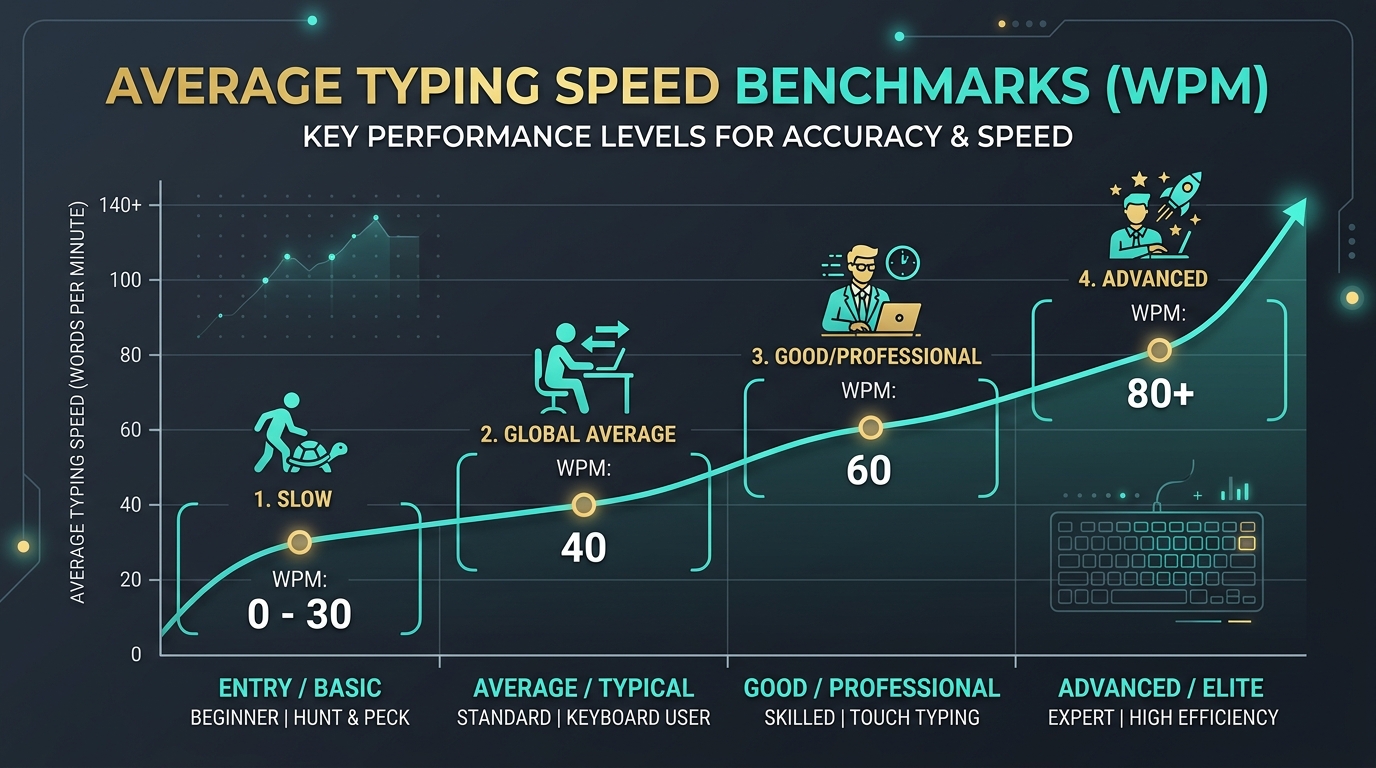
Knowing the average typing speed statistics helps you understand where you stand and set realistic improvement goals. This comprehensive analysis breaks down typing speed data by age group, profession, geographic region, and skill level, giving you a clear picture of how your WPM compares to the broader population.
Global Average Typing Speed: The Overall Picture
The global average typing speed across all demographics is approximately 40 WPM. This figure has remained relatively stable over the past decade despite increased computer usage, suggesting that most people type at a comfortable functional level without pursuing deliberate improvement. However, the distribution is wide. A significant portion of the population types below 30 WPM, while a smaller group consistently exceeds 70 WPM.
Accuracy averages around 92 to 95 percent for the general population. This means that the average typist makes between five and eight errors per 100 keystrokes. Professional typists typically maintain accuracy above 97 percent, and competitive typists often exceed 99 percent even at high speeds.
Average Typing Speed by Age Group
Typing speed develops predictably across age groups. Children aged 6 to 8 who are just learning to type typically achieve 5 to 15 WPM with low accuracy. By ages 9 to 12, with regular practice, most children reach 15 to 25 WPM with improving accuracy. Teenagers aged 13 to 17 who have grown up with computers average 25 to 40 WPM, though heavy gamers and programming enthusiasts in this group often reach 50 to 70 WPM. Adults aged 18 to 40 represent the fastest demographic, averaging 40 to 60 WPM. Professionals who type extensively in this age group frequently exceed 70 WPM. Adults over 40 average 35 to 50 WPM, though experienced professionals in this group often match or exceed younger averages. Seniors over 60 average 25 to 40 WPM, with significant variation based on computer experience.
| Age Group | Typical Skill Level | Average WPM | Target Accuracy |
|---|---|---|---|
| Ages 6–8 | Beginner / Exploratory | 5 – 15 WPM | 80% |
| Ages 9–12 | Intermediate / Foundations | 15 – 25 WPM | 90% |
| Ages 13–17 | Advanced / Native User | 25 – 40 WPM | 95% |
| Ages 18–40 | Peak Speed / Professional | 40 – 60 WPM | 97% |
| Ages 40+ | Experienced Specialist | 35 – 50 WPM | 97% |
| Ages 60+ | Casual / Standard User | 25 – 40 WPM | 95% |
Average Typing Speed by Profession
Typing speed varies significantly by profession. Administrative assistants and executive secretaries average 50 to 70 WPM with high accuracy. Data entry specialists average 60 to 80 WPM, with top performers exceeding 100 WPM on numeric data. Transcriptionists require 70 to 95 WPM for professional work, with medical and legal transcriptionists often at the higher end. Programmers and software developers average 50 to 80 WPM, focusing primarily on accuracy with symbols and special characters. Writers, journalists, and content creators average 50 to 70 WPM, with speed often fluctuating based on composition demands. Customer service representatives average 40 to 60 WPM. Court reporters and stenographers are in a separate category, using stenotype machines to achieve 180 to 250 WPM. Educators and teachers average 40 to 60 WPM. Healthcare professionals average 45 to 65 WPM, depending on documentation requirements.
| Profession / Role | Average WPM | Key Focus Area |
|---|---|---|
| Court Reporter / Stenographer | 180 – 250 WPM | Shorthand & realtime transcription |
| Professional Transcriptionist | 70 – 95 WPM | High accuracy auditory typing |
| Data Entry Specialist | 60 – 80 WPM | Numeric pad and spreadsheet data |
| Programmer / Software Developer | 50 – 80 WPM | Syntax, brackets & coding symbols |
| Writer / Content Creator | 50 – 70 WPM | Composition layout & formatting |
| Administrative Assistant | 50 – 70 WPM | Document templates & correspondence |
| Customer Support Specialist | 40 – 60 WPM | Live chat resolution & ticketing |
How Typing Speed Is Measured
Understanding how typing speed is measured helps you interpret statistics accurately. WPM, or words per minute, is calculated by dividing the total number of characters typed by five and then dividing by the time in minutes. Net WPM adjusts for errors by subtracting incorrect words from the gross WPM. Raw WPM measures your unadjusted typing speed including errors. Accuracy is the percentage of correctly typed characters out of total characters.
What Is Considered a Fast Typing Speed?
A typing speed of 60 to 70 WPM is considered good for professional purposes. At this speed, you can handle most clerical and administrative tasks efficiently. A speed of 70 to 80 WPM is considered very good and qualifies you for roles requiring above-average typing ability. Speeds of 80 to 100 WPM are considered excellent and are typically achieved by typists who have practiced deliberately for months or years. Any speed above 100 WPM is exceptional, placing you in the top 1 to 5 percent of all typists. If you are looking to improve your score, check out our 10 proven tips to increase your typing speed.
Global Variations in Typing Speed
Typing speed varies by region and language. English typists generally average 40 to 50 WPM, benefiting from the relatively short average word length and simple character set. Typists using languages with Latin-based alphabets such as Spanish, French, and German average similar speeds. Typists using non-Latin scripts such as Arabic, Hindi, or Mandarin often measure speed differently because character complexity varies significantly. Bilingual and multilingual typists may have different speeds in different languages, typically being fastest in their primary language.
Conclusion
The average typing speed of 40 WPM represents a baseline that most people can exceed with consistent practice. Understanding the statistics by age and profession helps you set realistic benchmarks for your own improvement journey. If you are below the average for your demographic, targeted daily practice can produce noticeable improvement within weeks. If you are above average, you may need more specialized techniques such as burst training or alternative keyboard layouts to continue progressing.