
How to Type Faster on a Keyboard: 10 Science-Backed Tips That Actually Work
Want to type faster? These 10 proven techniques will increase your typing speed fast. From proper posture to targeted drills, learn how to boost your WPM starting today.
Last updated: May 16, 2026
Learning how to type faster on a keyboard is one of the most valuable skills you can develop in the digital age. Whether you are a student writing essays, a professional drafting reports, or a programmer writing code, typing speed directly impacts your productivity. Research shows that the average person can improve their typing speed by 50 to 100 percent with consistent practice using the right techniques.
This guide covers ten science-backed methods for increasing your typing speed. These are not quick fixes but proven techniques that build lasting muscle memory and efficiency.
1. Master the Home Row Position
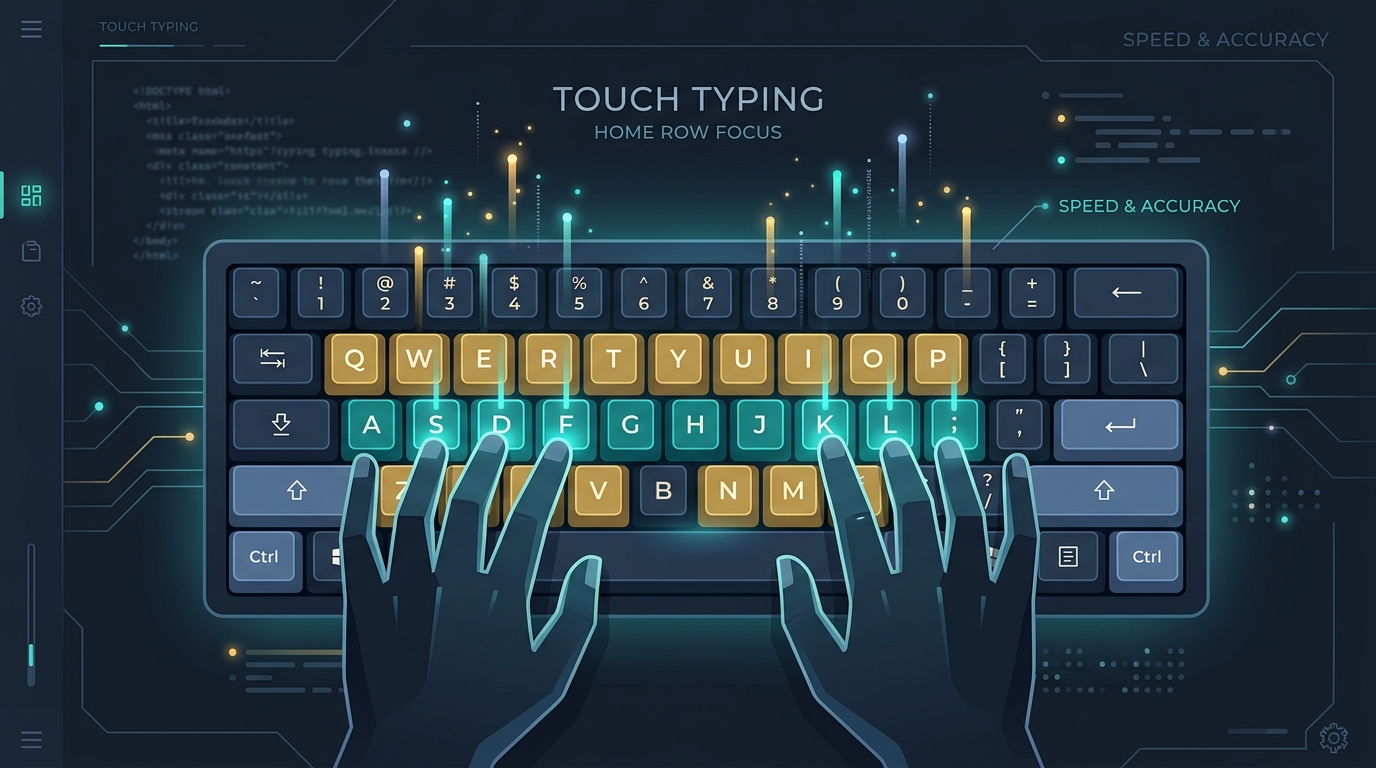
Every speed typist starts with the home row. Place your left fingers on A, S, D, and F. Place your right fingers on J, K, L, and the semicolon. Your thumbs rest lightly on the space bar. The tactile bumps on the F and J keys help you find this position without looking. From this anchor, each finger reaches up and down to its designated keys. This foundation is non-negotiable for fast typing. If you currently look at the keyboard while typing, commit to keeping your eyes on the screen. Your speed will drop initially, but within two to four weeks, you will surpass your original speed with better accuracy.
2. Focus on Accuracy Before Speed
This is the most counterintuitive but important principle of typing improvement. Every error you make requires correction time, which reduces your effective WPM. A typist hitting 100 WPM with 15 percent errors has a lower effective speed than one typing at 65 WPM with 99 percent accuracy. When you practice, slow down enough to type every word correctly. Speed is the natural result of accurate muscle memory, not something you can force through rushed practice.
3. Use the Right Finger for Every Key
Each finger has an assigned zone of keys on the keyboard. Using the correct finger for each key minimizes hand movement and maximizes speed. The left pinky handles Q, A, Z, and shift. The left ring finger handles W, S, and X. The left middle handles E, D, and C. The left index handles R, T, F, G, V, and B. The right index handles Y, U, H, J, N, and M. The right middle handles I, K, and the comma. The right ring handles O, L, and the period. The right pinky handles P, semicolon, slash, apostrophe, and shift. Violating these assignments creates awkward stretches that slow you down.
4. Practice with Short Daily Sessions
Consistency matters far more than duration. Fifteen minutes of focused daily practice produces better results than two hours once per week. The reason is neurological. Your brain builds myelin around neural pathways when you practice a motor skill repeatedly. Short, regular sessions stimulate this myelination process more effectively than infrequent long sessions. Set aside 15 to 20 minutes daily for typing practice. Use a timer and stay focused for the entire session.
5. Use Typing Tests as Diagnostic Tools
A typing test is not just a measurement tool. It is a diagnostic instrument that reveals your specific weaknesses. After each test, review which words or letter combinations caused errors. If you consistently struggle with th or ou combinations, create custom practice drills targeting those pairs. CheetahType provides character-level analytics that show exactly which keys cause you the most trouble, allowing you to focus your practice with surgical precision.
6. Try Burst Training Sessions
Interval training is effective for building typing speed, just as it is for athletic performance. Use a 15-second test mode and type as fast as you possibly can, ignoring errors. Rest for 30 seconds, then repeat. After five bursts, review your results to identify where you stumbled. This technique trains your nervous system to move faster by temporarily overriding your normal speed ceiling. Over several weeks, burst training raises your comfortable typing baseline.
7. Learn Touch Typing If You Have Not Already
Touch typing is the method of typing without looking at the keyboard using all ten fingers. If you currently use the hunt-and-peck method, switching to touch typing is the single most impactful change you can make. For a complete learning roadmap, follow our structured touch typing course to build your muscle memory from scratch. Swapping visual cues for tactile sensation is the key to unlocking true speed.
8. Optimize Your Keyboard and Workspace
Your physical setup affects your typing speed more than most people realize. Use a mechanical keyboard with tactile switches for the best typing feedback. Position your keyboard so your forearms are parallel to the floor. Keep your wrists straight, not bent up or down. Ensure your monitor is at eye level so you do not have to look down. A comfortable ergonomic setup reduces fatigue and allows you to maintain higher speeds for longer periods.
9. Practice with Varied Content
Typing the same passages repeatedly leads to memorization, which inflates your scores without building true skill. Practice with varied content to build genuine typing ability. Use random word tests to measure your real typing speed. Use punctuation-heavy text to challenge your symbol key accuracy. Use code snippets if you are a programmer. The more varied your practice material, the more versatile your typing skill becomes.
10. Track Your Progress Systematically
What gets measured gets improved. Take a standardized typing test at the same time each day and record your results. Track both WPM and accuracy over time. Look for trends. If your speed plateaus for more than two weeks, change your practice approach. Try longer test durations, different text types, or burst training to break through the plateau. Seeing your improvement graph rise over weeks and months is one of the most motivating aspects of typing practice.
Conclusion
Learning how to type faster on a keyboard is a gradual process, but the improvement is predictable and reliable if you use the right techniques. Start with the home row, prioritize accuracy, practice daily, and use typing tests as diagnostic tools rather than just scoreboards. Within three months of consistent practice, most typists can increase their speed by 20 to 30 WPM. Your fingers have the potential to move much faster than they currently do. Consistent deliberate practice is the key that unlocks that potential.